

HOE INHERITANCE RECEIVED BY NON-RESIDENTS IN SPAIN ARE TAXED
When non-residents of Spain inherit property in Spain, they are obliged to pay Inheritance and Gift Tax. But the way in which this tax is paid depends on many factors.
Was the deceased relative a resident or non-resident? Is the heir resident in Europe or outside the European Community? In each case there are provisions to be taken into account. We will explain each of them in detail below.
The tax to be paid in the case of inheritance received by non-residents
In Spain, Inheritance and Gift Tax (ISD) is levied on the increase in wealth obtained by individuals through inheritances, bequests, gifts or any other type of inheritance. It is also levied on the proceeds of life insurance.
This tax must be paid by the person receiving the inheritance. In the case of non-residents, they only have to pay ISD based on the value of the inherited assets located in Spain.
Inheritance tax is administered on a regional basis. Therefore, each Autonomous Community enacts its own regulations, with different quotas, reductions, deductions or allowances.
However, the State Tax Administration Agency (Agencia Estatal de Administración Tributaria) assumes the management of Inheritance and Gift Tax in the event that the deceased (causant) was not resident in Spain at the time of death.
But let us look at each of the cases that may arise when a person not resident in Spain inherits assets in Spanish territor.
How is a non-resident heir taxed?
It is necessary to analyse the different cases, depending on the place of residence of both the deceased and the heirs.
If the deceased was resident in Spain
If the deceased relative resided in Spain at the time of death and owns assets in Spanish territory, 2 situations are established:
- That the heir does not reside in Spain, but resides within the European Union or the European Economic Area (EEA). In this case the heirs do not residents are entitled to benefit from the regulations of the Autonomous Community in which the deceased resided.
- The heir does not reside in Spain, but resides outside the EU and EEA. The non-resident heir must pay ISD in Spain applying the rules of the Autonomous Community in which the highest percentage of the value of the inherited assets is located.
It is important to note that if the deceased relative owns assets only outside Spain, the non-resident heir does not pay tax to the Spanish tax authorities.
If the deceased was not resident in Spain, but was a resident of the EU or the EEA
In the event that the deceased relative was not resident in Spain at the date of death, but was resident in a country within the European Union or the European Economic Area:
- The non-resident heir in Spain must pay ISD applying the regulations established by the Autonomous Community in which the highest percentage of the value of the assets is located.
If the deceased was not resident in Spain, but outside the EU or the EEA
In the event that the deceased had resided in any country in the world, but outside the European Union or the European Economic Area, at the date of death, the following applies:
- The non-resident heir in Spain must pay Inheritance and Gift Tax (ISD) under the State regulations of the AEAT.
In any case where the deceased relative was not resident in Spain at the date of death, and only had assets outside Spain, the non-resident heir is not liable to pay ISD.
Where must inheritance tax be paid?
Regardless of whether the regulations of the Autonomous Community in which the deceased resided or in which the highest value of the inherited assets is located in Spain should be applied, non-resident heirs in Spain:
- They must settle Inheritance Tax with the State Tax Administration Agency, at the National Tax Management Office – Inheritance Division of non-residents.
How is Inheritance Tax calculated?
To find out exactly what you have to pay, you need to carry out the following operations:
Calculating the tax base
The tax base is the amount on which the tax is to be calculated. In order to determine the taxable base, the estate is first determined, then any deductible charges are subtracted.
Inherited estate = sum of the actual value of all inherited assets in Spain.
- Inherited assets include real estate, shares, accounts, household goods (utensils, household goods, furniture…), etc.
Taxable income = estate – possible deductible charges
- Deductible charges can be, for example, funeral expenses or debts owed by the deceased at the time of death, such as a mortgage loan.
Some assumptions
To know the tax base per heir:
Taxable amount per heir = taxable amount / number of heirs.
If there is life insurance, the taxable amount of the heir designated as beneficiary must be increased by the amount received from the insurance:
Calculating the taxable base
To calculate the taxable base, the taxable base is taken and the statutory reductions are subtracted.
Net taxable income = taxable income – reductions established by law.
The reductions can be for kinship, disability, inheritance of historical and cultural heritage, etc. The reductions are applied at state level and then those of the respective Autonomous Community.
For example, in Andalusia a reduction of up to 1,000,000 euros is established for kinship, provided that:
- The heir is the spouse, common-law partner, descendant/adopted or ascendant/adoptive of the deceased person.
- The heir has a pre-existing estate not exceeding 1,000,000 euros. How does it apply? Let’s see:
Net taxable income = taxable income – 1.000.000 euros
Calculation of the gross tax liability
The total tax liability is obtained by applying the tax percentage established by the Autonomous Community to the taxable base:
Total tax liability = taxable base x tax percentage established by the Autonomous Community.
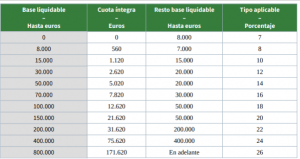
State laws establish a range for the tax rate between 7.65% and 34% of the taxable base.
For example, in Andalusia, the following rate applies, effective from 1/January/2022:
Calculating the tax liability
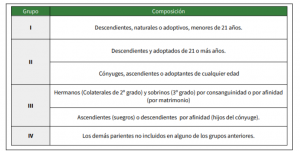
Is obtained by multiplying the total tax liability by a pre-established coefficient, according to the degree of kinship and the pre-existing assets of the heir. State laws establish a range for the multiplying coefficient between 1 and 2.4.
Tax liability = full tax liability x multiplier coefficient established by the Autonomous Community
In Andalusia, a single multiplier coefficient for the different degrees of kinship was established as of 1/January/2022. It does not take into account the pre-existing assets of the heir:

Where:
Calculating the amount payable
Finally, the amount payable will be the result of applying the relevant allowances or deductions to the tax liability, in accordance with the provisions at national level and in the respective Autonomous Community.
Amount payable = tax liability – allowances and deductions
For example, one of the state deductions that is applied is for international double taxation, the purpose of which is to avoid the heir paying a similar tax twice in two States.
If you have any doubts, please contact us. At ABOGADOS MAR CONSULTORES we can advise you and help you to manage the settlement of Inheritance Tax in Spain, regardless of where the assets are located.


Leave a Reply
Want to join the discussion?Feel free to contribute!